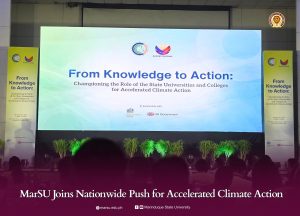
Diliman, Quezon City, Philippines — On December 9, 2025, Marinduque State University (MarSU) President Prof. Diosdado P. Zulueta joins the high-level national forum “From Knowledge to Action: Championing the Role of State Universities and Colleges for Accelerated Climate Action”, held at the GT–Toyota Asian Center Auditorium, UP Diliman, Quezon City.
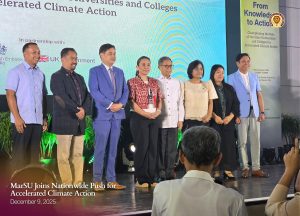
Organized by the Climate Change Commission (CCC), the forum brought together SUC leaders, government agencies, legislators, development partners, and climate experts to strengthen the role of higher education institutions in implementing the National Adaptation Plan (NAP) 2023–2050.
The program opened with Welcome Remarks from DENR Secretary Raphael P.M. Lotilla, who stressed that SUCs must lead the country’s climate action efforts. He highlighted their responsibility to nurture climate-conscious graduates and fully adopt sustainability practices—such as implementing the Ecological Solid Waste Management Act—across campuses. Lotilla emphasized that SUCs should act as catalysts for innovation, reflection, and decisive action.
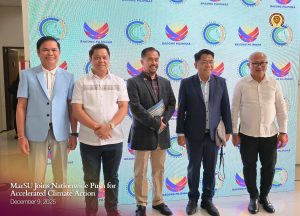
CCC Vice Chairperson and Executive Director Robert E.A. Borje delivered the Opening Message, recognizing SUCs as key partners capable of bridging scientific research with practical, community-based solutions. He underscored that universities possess the technical capacity, expertise, and influence necessary to strengthen local climate governance.
Senator Loren Legarda, Chairperson of the Senate Committee on Higher, Technical, and Vocational Education and UNFCCC National Adaptation Plan Champion, delivered the keynote address. She warned that the climate crisis is no longer a distant or isolated problem but a direct threat to national development, noting that the Philippines faces far more than stronger storms.
In her message, Senator Legarda urged SUCs to make climate awareness an essential part of academic and campus life. She called on universities to mainstream climate education across all disciplines, ensuring every graduate—regardless of program—understands climate risk, adaptation, and resilience. She also advocated for establishing Climate Innovation Hubs in every region to support local governments in integrating climate action into development and investment plans. Finally, she encouraged SUCs to lead by example through net-zero policies, eliminating single-use plastics, and promoting sustainability-centered operations and events.
The program continued with technical discussions, including an overview of the National Adaptation Plan 2023–2050, and a presentation by PAGASA on the localization of climate analytics and its importance for evidence-based planning. Afternoon sessions featured SUC-led case studies showcasing local climate solutions. A panel discussion followed, highlighting the value of translating scientific knowledge into practical, community-led action.
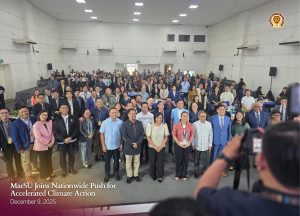
Government agencies, including DHSUD, DOF, and DILG, expressed strong support for aligning their programs with the National Adaptation Plan. The forum concluded with the Signing of the Commitment to Action, led by CCC officials, ULAP, PASUC, and DILG.
[J. Breganza]#EmpoweringMindsTransformingLives#MarinduqueStateUniversity#SDG13ClimateAction#SDG4QualityEducation#SDG11SustainableCitiesandCommunities#SDG17PartnershipsfortheGoals